Mary Wild Takes us on a Psychoanalytical Tour of Horror Cinema in Psychoanalyzing Horror Cinema
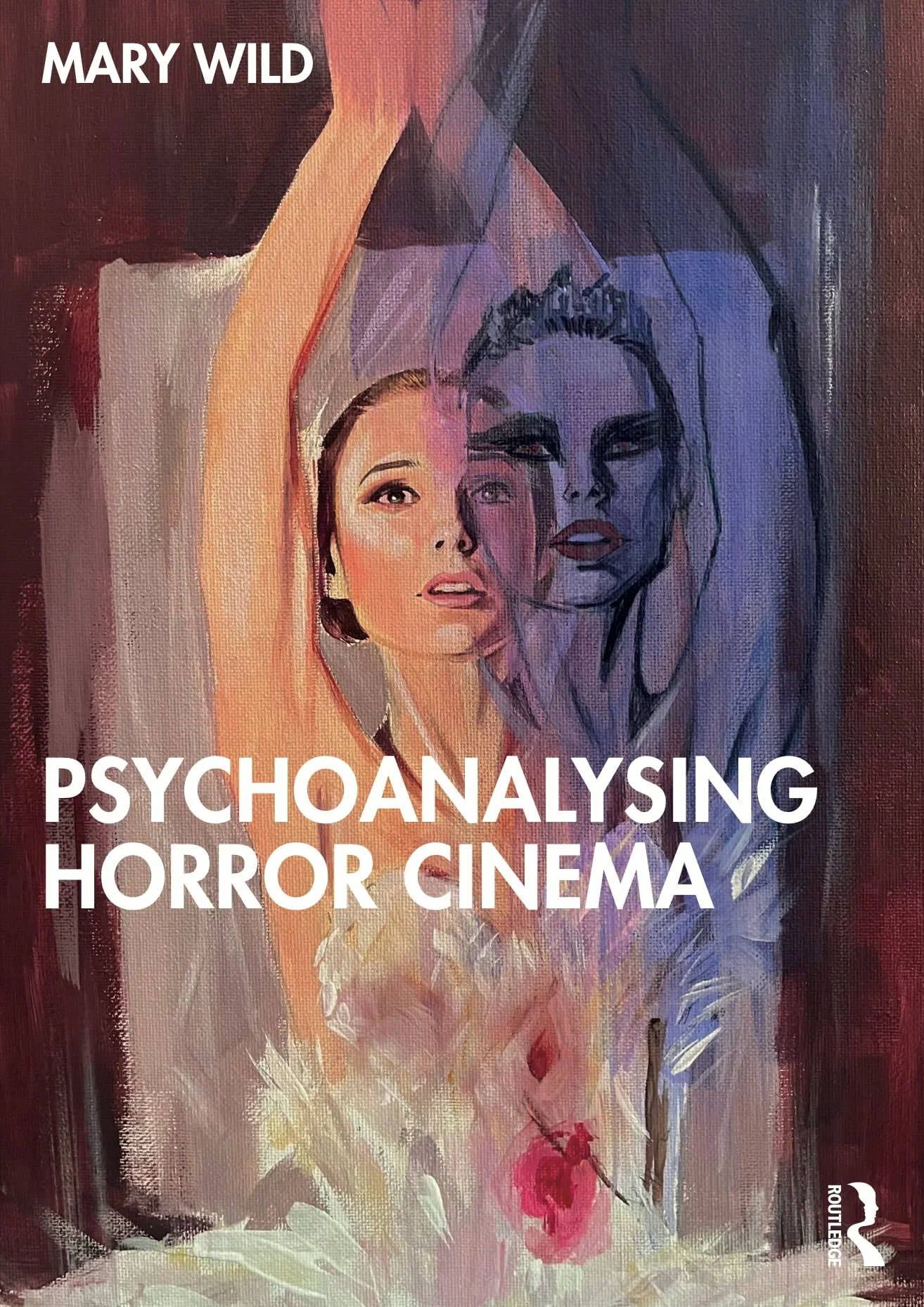
Book Cover for Psychoanalyzing Horror Cinema - designed by Suspiria Vilches
I have long admired Mary Wild’s use of psychoanalysis to approach horror and genre cinema, so it has been a true delight of mine to review her book Psychoanalyzing Horror Cinema. I have been privileged to have Mary appear as a recurring guest on my podcast Fishnets and Philosophy, and I am incredibly lucky to consider Mary a close friend and confidant. It was a pleasure to be afforded the opportunity to review her book.
I first discovered Mary’s work by hearing her dulcet tones reading out incredibly interesting psychoanalytical deep dives into horror films during her Wild About Horror segments featured on Mike Muncer’s podcast Evolution of Horror. Mary has now taken those segments and amalgamated them into this treasure trove of insights into horror and genre cinema. This book takes those readings further, expanding on them, and making them richer. Mary also introduces readings of films that her segments on the podcast did not touch on. This broadening out of each theme shows the vastness of Mary’s knowledge and adds more depth to each theme touched on in the book.
In the introduction to her book Mary lets the reader know “that I narrate the segments in a style that leans towards ASMR – low, steady tones intending to soothe, lull, and invite intimacy”, and whilst reading this book I was taken back to hearing those segments for the first time, in many ways it felt like Mary was personally reading the book to me. Those who are familiar with Mary’s Wild About Horror segments will know how much passion Mary pours into each piece of analysis, and this book is a tangible invitation into Mary’s intellectually curious mind.
The strength of this book is that one does not need to have listened to any of the Wild About Horror segments to appreciate Mary’s insights. Mary’s authorial voice is strong and joyously brings the reader on a journey through a rich discussion of film. Throughout this book Mary is extending a hand to the reader, opening a dialogue and asking you to look at these films in a way that you may not have before. This book encourages the reader to embrace curiosity and is a testament to one of Mary’s many qualities, the strong belief that there is no such thing as a film which does not merit analysis. This book touches on a variety of films across the horror cinema, and it truly makes this collection of psychoanalytical essays stand-out.
Something else that I personally found so incredibly useful while reading this book is that Mary closes each chapter with a useful glossary of terms that had been used and helps break these concepts down so there is no ambiguity. I often find that a lot of academic writing is lecturing at you and almost akin to a zealous preacher at the pulpit. Mary’s book is full of her personality, playful and inviting, and truly an incredibly satisfying read. I had the chance to catch up with Mary recently and I asked her some questions for this review:
Tadhg: “Out of all your Wild About Horror segments, was there one you were most excited to revisit for this book?”
Mary: “Yes, there was one I was particularly fond of, in terms of the joy of writing it, and that was the segment on Predator. The reason why is; that I just thought of applying psychoanalysis to Predator is that it does seem to be focusing on a stereotypical male or masculine condition, I find it comical in a way that men are being watched, and that is why they feel vulnerable. In many ways it is a reversal of misfortunes, usually the male gaze is predatorial, and in a way they are getting a taste of their own medicine.”
Tadhg: “Are there any more recent films you feel would have been perfect candidates for your book?”
Mary: “Yes, definitely. I would have loved to have included The Substance under the theme of Body Horror. I just think there is so much in it, I keep coming back to it all the time. It is a perfect thought experiment, so philosophically rich, and a powerful feminist manifesto. It is truly enriching, and I feel I am a better woman because of it; it has been a gift. I gained such a deeper understanding of femininity in a time of phallocentric dominance.
Tadhg: “What’s next for Mary Wild? Any future creative projects in the works?”
Mary: “Yes, so I am already starting to work on book number 2, I have really got the writing bug now, which I never thought I would say. I never used to think of myself as a writer, I always thought of myself as more of a talker really, lecturing and podcasting. This book was really a baptism by fire, and I think it sort of eliminated any kind of self-doubt that was stopping me from engaging meaningfully with writing. Now I am working on book number 2 which is a radically different concept. The first one as you know was 50 films written in a personal essay style, book number 2 is actually focusing on one film only, and essentially I am going to be writing in the format of auto-fiction So, I am looking forward to that, it is going to be a very different type of writing experience.”
Mary Wild’s book Psychoanalysing Horror Cinema is published by Routledge and can be purchased here. You can keep up to date with Mary’s upcoming projects and future lecturing series by following her @psycstar across social media.